
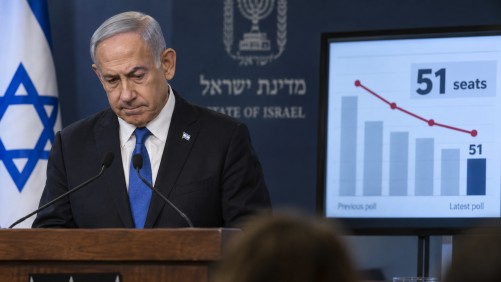
A recent poll indicates that if elections were held today in Israel, Prime Minister Benjamin Netanyahu’s political bloc would secure 51 seats in the 120-member Knesset, while the main Zionist opposition bloc would capture 55 seats. This outcome leaves neither bloc with the 61 seats needed to form a majority government, highlighting continued political uncertainty ahead of the October 27 election.
The survey reveals that two Arab-majority parties are projected to gain a combined total of 14 seats, potentially positioning them as key players in coalition negotiations. Former IDF chief Gadi Eisenkot’s Yashar party leads the pack as the largest single party with an estimated 24 seats. Meanwhile, Naftali Bennett’s B’Yachad is expected to win 14 seats, Yisrael Beytenu nine, and the Democrats eight.
Within Netanyahu’s bloc, Likud is slated to win 22 seats, followed by Shas with 10, United Torah Judaism with nine, Otzma Yehudit with seven, and Religious Zionism with four. However, Ofer Winter’s People of Israel party, along with HaMiluimnikim and Blue and White, failed to reach the 3.25% electoral threshold necessary to enter the Knesset.
In the event of another electoral deadlock, public opinion is divided on the preferred course of action. Approximately 31.4% of respondents favor another election, whereas 29.6% support forming a unity government, and 27% back a minority government. Among Netanyahu’s supporters, 45.02% would prefer a unity government, while those opposed to him largely favor a minority government, with 39.79% in support.
The poll surveyed 500 respondents and carries a margin of error of 4.4 percentage points, reflecting the ongoing challenges in forming a stable government in Israel’s fragmented political landscape.